
This is an old revision of the document!
Table of Contents
Workflow Schedules Version 2.5 and after
When Bizweaver workflows are in active use (in production), they are at times executed using a schedule. This means that they will execute automatically at a defined time. No user action is required.
A schedule is created by selecting the desired combination of options as described below. If both the schedule and the workflow are enabled, the workflow will execute automatically at the appropriate time.
Creating a Schedule
To create a schedule for a workflow:
- 1. Open the workflow so that it is currently active.
- 2. Click the Schedule link. The link will show when the next execution of the associated schedule is due to occur.

- The Schedule information window opens. This is where the schedule for this workflow is maintained.
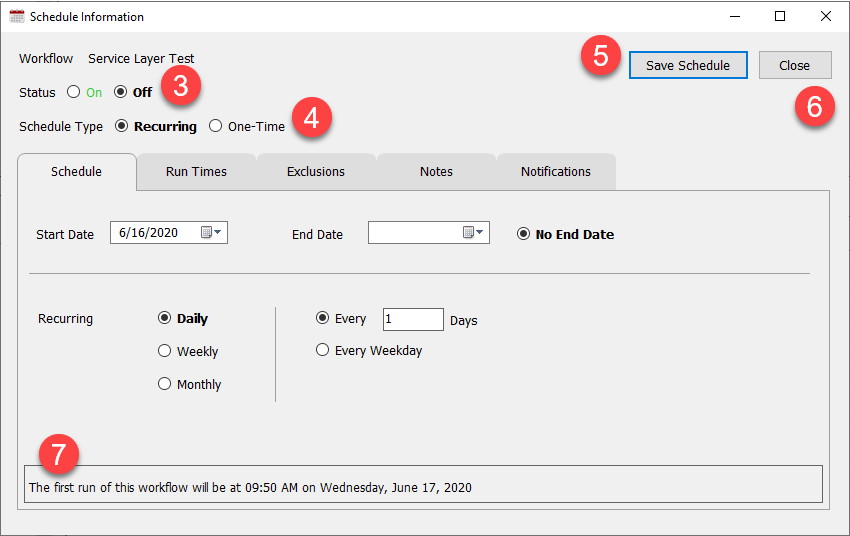
- 3. Status Indicates if schedule is on or off.
- Schedule will not run if off is selected
- 4. Schedule Type
- Recurring - defines the occurrence of a workflow over multiple days
- One-Time - defines the occurrence of a workflow on a single day
- When running a One-Time schedule the scheduler display will change, and only one date can be selected this will be the date the schedule runs. Below are the tabs that will be displayed for modification.
- 5. Save Schedule
- This will save the schedule and the workflow.
- The Save workflow compiler will open once this button is clicked.
- 6. Close
- This will close the schedule and no changes will be saved.
- 7. Message
- This message will show the first run of the schedule based on current setting.
- This message will display on the Schedule Tab and Run Times Tab.
- This message will change if Run Continuously or Run Every is selected
Schedule Tab
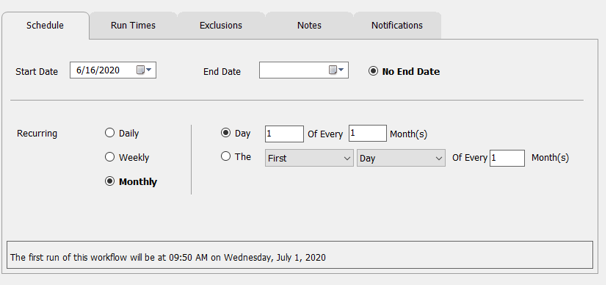
- 1. Start Date and End Date define when the schedule starts and ends.
- Start Date will default to the current date.
- When a pre-existing schedule is opened, the start date will reflect the current date. This will be the new start date when the schedule is saved (it cannot be back dated). If Cancel is selected or the scheduler window is closed, the start date will remain as it was.
- No End Date option is used if you do not want the schedule to have a set end date.

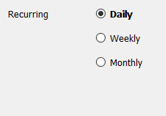
- 2. Recurring select the type of schedule.
- Options are Daily, Weekly, Monthly.
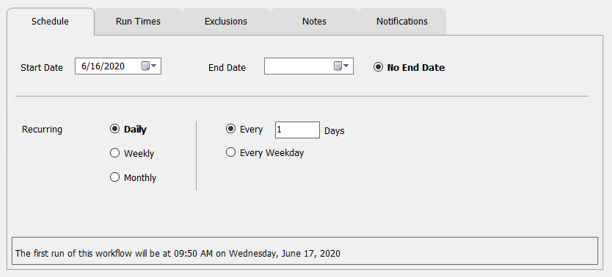
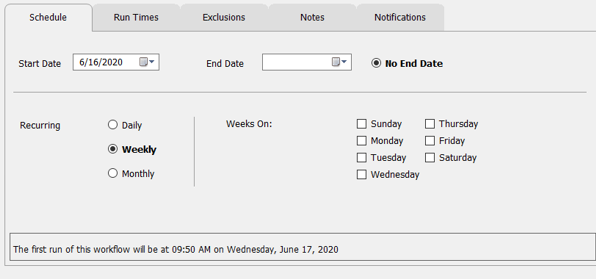
- 3. The options in this section change depending on the type of schedule selected.
- Daily
- Weekly
- Monthly
Run Times Tab
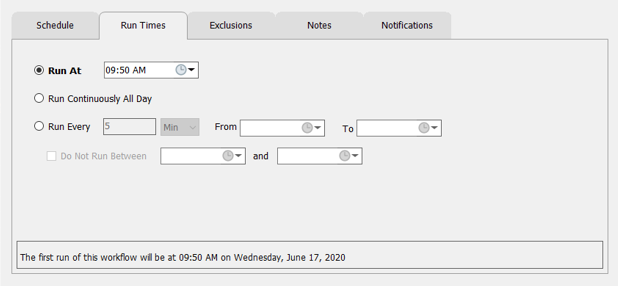
- 1. Run At defines a specific time a schedule should run during a day.
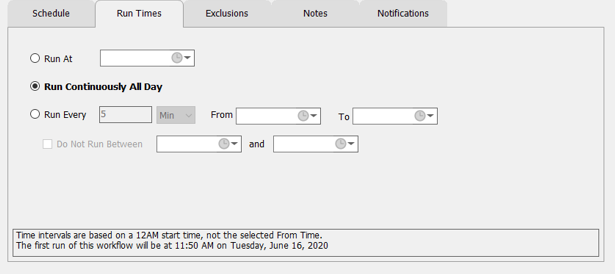
- 2. Run Continuously defines a schedule running all day during the selected schedule type
- Run Continuously time intervals are based on a 12:00 AM start time. This interval runs every 5 minuets.
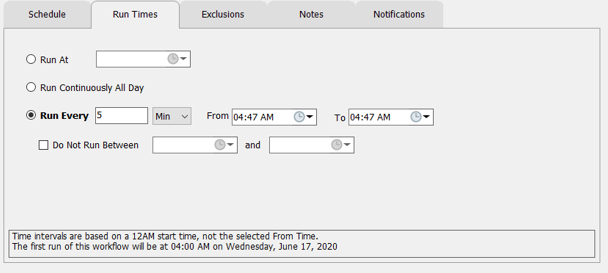
- 3. Run Every defines a schedule running during a set interval of time
- Bizweaver uses the indicated interval period (ex. 5 mins, 12, mins, 20 minutes, i.e. whatever the user enters) calculated out from 00:00 to determine the actual first run of the workflow within the selected From-To range.
- The From and To times can only be selected within a given date and cannot span multiple dates/days
- Example: Run Every 7 Min From 02:00 AM To 04:00AM. The first run of the workflow will be at 2:06AM. 00:00 + 18 intervals of 7 min = 02:06AM The last run of the workflow will be at 3:57
- Minutes - Can choose from 5 to 59 minuets as an interval
- The From and To times need to have sufficient time for each interval range
- Example: If a schedule has a 30 minute interval there needs to be more then 30 minutes between the From and To times
- Hours - Can choose from 1 to 23 hours as an interval
- The From and To times need to have sufficient time for each interval type
- Example: If a schedule has a 1 hour interval there needs to be more then 1 hour between the From and To times
- Do Not Run Between - defines a time a schedule will not run.
- This will effect the amount of time in the From and To times
- Example: A schedule is set from 9:00 AM to 5:00 PM which is 8 hours, if an exclusion is set from 10:00 AM to 12:00 PM the 8 hour time frame originally defined reduces now to 6 hours due to the exclusion. If the schedule runs every hour during this time frame it will only run 6 times during the given time frame due to the exclusion.
Exclusions Tab
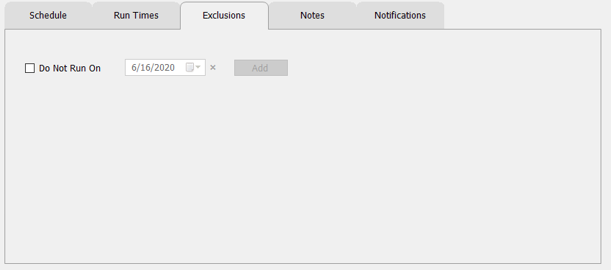
Exclusions are dates you do not want to run schedules on. The maximum amount of exclusions is 10
- 1. Do Not Run On defines a specific day a schedule should not run.
- The tab will display the number of current exclusions.
- If a exclusion date is in the past the “X” will change to red.
Notes Tab
This tab allows notes to be entered for a schedule.

Notifications Tab
Notifications allows a user to add email addresses to a workflow schedule. This will send an email when the workflow has started or ended depending on the option chosen.
If the Bizweaver Service is restarted all enabled workflows with this option enabled will send emails. It is recommened to have a email specifically set to send start and end notifications emails to.
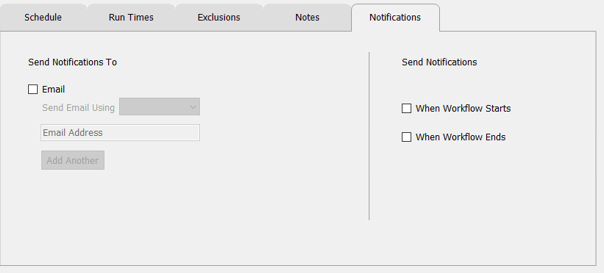
- 1. Send Notifications To defines an email to send the notification to.
- Send Email Using - defines the SMPT connection to be used for sending the emails.
- Email Address - defines the email that will recieve the notification. Limit 3 emails
- If a email is added by mistake an “X” will appear to remove the email
- 2. Send Notifications
- When workflow starts - This will send a email notification when a workflow starts.
- When workflow ends - This will send a email notification when a workflow ends.


