
This is an old revision of the document!
Table of Contents
Introduction (Bizweaver)
This set of pages provides an overview of the Bizweaver data integration application.
Audience
This document is intended for developers of Bizweaver workflows. Knowledge of standard SQL (Microsoft T-SQL) statements is required.
Related Pages
The following pages contain additional information about the specific components used to construct Bizweaver workflows.
General Overview
The Bizweaver application is set of tools used to automate data acquisition, data manipulation, file management activities, as-well-as providing data integration into SAP Business One. The various tools provided by Bizweaver are linked together as a set of sequential steps called a workflow.
Bizweaver Application Overview
The Bizweaver application home screen consists of six areas.

Icon Bar
The Icon Bar provides access to various Bizweaver options and tools used to manage the application.
“Currently active” in the following discussions means that a workflow has been selected and is displayed in the design area.

 Create new workflow: This clears the workflow design area to begin a new workflow.
- Any changes that have not been saved in the workflow currently displayed in the design area will be lost.
 Search: Allows you to search workflows by ID number or text string.
- Select the “Search by text” checkbox to search by text string.
- Select a row from the list of items displayed and click [Open] to open the workflow for editing.
 Save: Saves the currently active workflow.
Enhanced information regarding the save (and duplicate) process is provided beginning in Bizweaver version 2.4.
 Duplicate: This will duplicate the currently active workflow.
- Use this option to create a copy of an existing workflow. The new workflow can be saved in the current folder, or in a different folder. In either case, it will be saved with the same name as the original, but with a different workflow ID.
 Delete: This will delete the currently active workflow.
- A deleted workflow cannot be recovered.
 Explorer View: This will enable the Explorer view of Bizweaver. This is the default view when Bizweaver is opened.
 Design View: This will enable the Design view of Bizweaver. This view displays only the workflow tools and the design area.
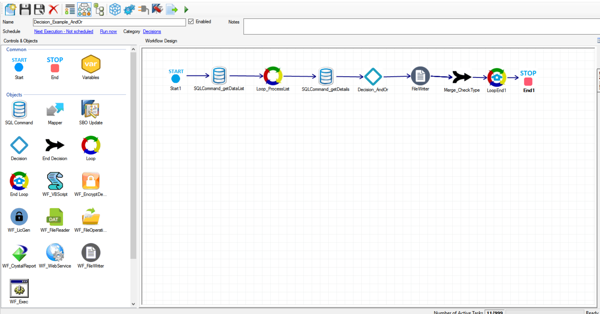
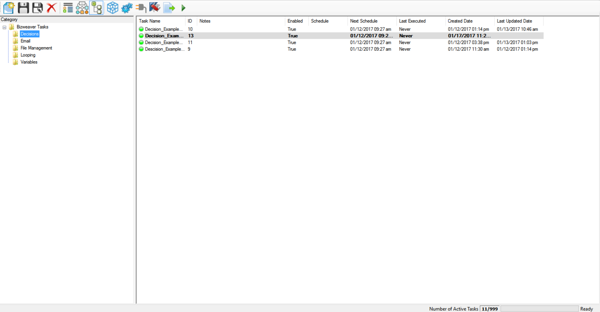
 Task List View: This will enable the Task List view of Bizweaver. This view displays only the groups and lists of tasks.
You can switch views at any time.
 Register Assembly: Used only when specific tools need updating.
- Some workflow tools are independent of the core Bizweaver application, including custom tools. Standard tools are registered automatically during installation/upgrade. The Register Assembly function is used only when a specific tool needs to be updated. This function should only be used as directed by Third Wave support personnel.
 General Settings: This is the general configuration for Bizweaver.
- Additional information is found here.
 Global Connections Configuration: This is used to define connections to database engines (SQL Server & HANA), email services, REST web services, and SAP Business One integration tools (DI Server, DI API).
- Additional information is found here.
 Restart SAP Business One DI Server service: This is only used when Bizweaver is being used with SAP Business One.
- Start Bizweaver using the right-click > Run as administrator option to ensure the process has adequate operating system permissions.
 Export / Import: This is used to export and import Bizweaver workflows.
- Additional information for these processes is found here.
 Test Run (Debug) Tool: Executes the currently active workflow in test/debug mode.
- Additional information is found here.
 View Job Log: This allows you to view the job log for the currently selected workflow.
- The job log displays only log activity for workflows executed using the “Run Now” option or on a schedule.
Explorer Area
The “Explorer Area” provides the ability to create/store workflows in folders. These groupings are for organizational convenience only and have no effect on the use of the application. In the standard Explorer area view there are two “panes”; the Folders pane (on the left) and the Workflow pane (on the right). The Workflow pane presents the contents of the folder selected in the Folder pane To add a new folder:
- Select (highlight) the desired parent folder.
- Press the [Insert] key or right-click the parent folder and select Insert to add a child folder (one level below the selected parent) OR click “New Root” to create a new parent folder.
- Enter the name of the new folder
To delete a folder:
- Move (or remove) any workflows that are in the target folder.
- A folder cannot be removed if it holds any workflows.
- Select (highlight) the desired folder.
- Press the [Delete] key or right-click the parent folder and select Delete.
- The folder is deleted.
Workflow List Pane
The Workflow List pane displays a list of workflows in the folder selected in the Folders pane.

- Workflow Enabled/Disabled Icon
- This icon is found just to the left of the workflow name. It indicates whether the workflow is enabled or not.
- A green icon indicates that the workflow is enabled.
- No icon indicates that the workflow is disabled.
- Click in the icon area to enable or disable a specific workflow.
- Your license indicates the number of workflows that can be active. The counter is found in the lower right corner of the Bizweaver screen.
- Workflow Name
- Workflow ID
- This is an internal ID number that is used when initiating a workflow through the Bizweaver web service.
- Notes
- These notes can be added to the workflow as described later in Building A Workflow.
- Enabled
- Provides the same information as shown with the Workflow Enabled/Disabled Icon (item 1 above)
- Schedule
- Name of the schedule associated with this workflow.
- See Workflow Schedules for more information.
- Next Schedule
- Date & time this workflow is next scheduled to execute.
- Last Execution
- Date & time this workflow was executed using a schedule.
- Does not reflect date & time the workflow was executed manually.
- Created Date
- Date & time the workflow was created.
- Last Updated Date
- Date & time the workflow was last updated (modified).
Bizweaver Tools Pane
The tools used to construct Bizweaver workflows are found in this area. They are added to a workflow by dragging them from the Tools area into the Design area. See the Workflow Tools page for descriptions of the tools. Details on each of the tools are found in other Bizweaver documents.
Workflow Design Pane
This area is the “design area” where a workflow is constructed. See the following sections of this document form more information.
Bizweaver version 2.5 and above the ability to click and drag within the design pane grid was added.
Task Counter

As noted earlier, your license controls the number of active (enabled) tasks you may have. The right-hand number indicates the number of licensed workflows. The left-hand number indicates the number of workflows that are currently enabled.
Building a Workflow
It is strongly recommended that prior to constructing a workflow you spend some time reviewing your requirements, workflow solution design options and approach, and what Bizweaver tools you may need. Workflow construction tends to be easier and more efficient because of this pre-planning.
Details for building a workflow are found here.
Execute a Workflow
There are three methods to execute a Bizweaver workflow: test/debug mode, “run now,” and scheduled. The results are the same for all methods.
Test/Debug Mode
The Bizweaver Test Run Tool allows a developer to execute a workflow in a step-by-step manner. Variable values can be examined at each step to confirm that they are what is expected. More information on this tool is found here.
Run Now
The “Run Now” option is used to execute a workflow while in Bizweaver. There are two ways to use this option.
First, the currently active workflow can be executed by clicking the “Run now” link as shown below.

Second, right-click on any workflow in the Workflow List area, and select the “Run now” option.
In both cases, the workflow is executed immediately. No feedback is provided while the workflow is executing (as seen in the Test Run tool).
Run Now Log
At the end of the execution a “Task Execution Status” window is automatically displayed showing the log information for the workflow.

In general, you will only need to scan the log records for information in the “Message” column. These will typically be error messages that may need attention.
Click on the Open Log File link to open a text file of log information. This file will have more technical information and can be saved for further review.
Click the [Close & Delete Log Records] button to delete the log information from the Bizweaver logging table, and close the window.
Click the [Close] button to close the window. An additional dialog will allow you to delete the log records here as well.
Note that the log records can be retained if desired. This can be helpful if you are doing reporting from the Bizweaver log table. See Appendix C – Activity Logging for more information.
Scheduled Execution
Bizweaver workflows can be automatically executed based on a schedule. This is the most common, and most efficient, way to execute workflows. See Workflow Schedules for more information.
Workflow Variables
“Variables” are data values that are held in memory during the execution of a workflow. There are two types of variables in Bizweaver: User Variables and Step Variables.
User Variables are defined by the user. These values can be defined in the Variables tool or they can be created using the VBScript tool.
Step Variables are special references created by the Bizweaver application. Most Bizweaver workflow tools create these variables as the step is executed. An example of this would be a reference to an output column from a SQL Command: Reader step.
Bizweaver variables are available to other workflow steps that follow the step where they are created.
More information is found on the Using Variables page.
Bizweaver Activity Logging
As noted earlier in this document, actions from the Test Run tool are logged in text files. However, when a schedule executes a workflow, or using the “Run now” option, step information is logged to the SQL database used by Bizweaver.
Transaction logging data is found in the table VGO_SYNC_PROC_LOG. An entry is made for each workflow step that is executed. In addition to workflow and step information, any errors reported from Bizweaver steps is recorded. This provides a mechanism for reporting execution issues.
The log table can be accessed via SQL Management Studio or from a report in Versago. Following is a SQL Select statement to access this information.
SELECT

t0.JobID, t0.TaskID, t1.TaskName, t0.StepType, t0.Step, t0.[TIME], t0.Message

FROM vgo_sync_proc_log t0

INNER JOIN VGO_SYNC_TASKS t1 ON t0.TaskID = t1.TaskID
The log information for a specific workflow can also be accessed using the “View Job Log” function described in the “Icon Bar” section of this document.


