
This is an old revision of the document!
Table of Contents
Setup
Basic configuration about the data view is defined on the Setup page.

Information
- Name is a unique name for this data view.
- Title is displayed in the Versago user menus
- Category is the grouping mechanism used in the default Versago menu structure.
- Previously defined categories can be selected from the drop-down list. A new category can be created by typing the desired value and selecting Add from the drop-down.
- Description is an optional internal explanation of the data view.
- Instruction is displayed at the top of the user data view page.
Availability
- Roles define the group of users that have access to the data view.
- Activate the Public option if the data view should be available prior to a user logging in.
- Activate the Do not show in menu option when you have a report that you do not want to be displayed in the standard Versago menu structure.
- The most common use of this option is when the report is only used as a lookup tool in Versago Forms, or as a sub-report in other Versago Reports.
Presentation Format
- List or Chart format is the default “row & column” presentation.
- Enable Paging is used in conjunction with Page Count if you want to ensure that a specific number of records are displayed on each page.
- The Schedule format presents the data view in a calendar. See the Schedule page for additional configuration information.
Connection
- Select the Connection Name from the list of configured connections. See the Connections page for information on configuring database connections.
- When a connection is selected, the associated database name is displayed to the right.
- Select the Data Source Type
Data Source Types

SQL Query
When this option is selected, a SELECT SQL statement can be entered manually or pasted from another source such as SQL Server Management Studio.
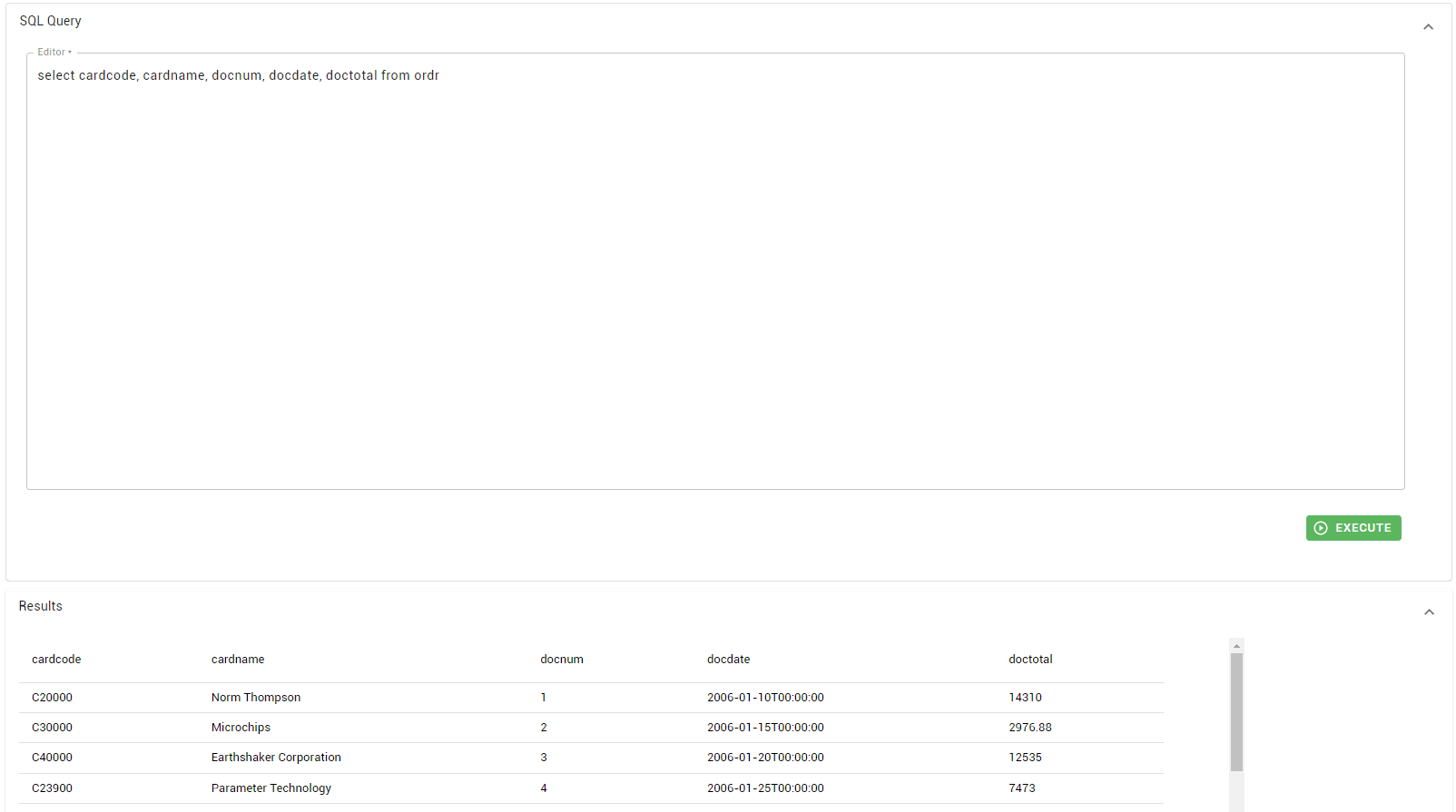
- Enter the SELECT statement in the “Editor” area.
- Click [Execute] to validate the statement.
- Standard SQL error messages will be displayed if errors are encountered.
- If the statement is correct, the first 50 records of the dataset are displayed in the “Results” area.
SQL Statement Restrictions
- An Order By clause cannot be used except in cases where the statement contains a TOP operator. The ordering (sorting) is handled by the data view's Field Display settings
- Computed values in the SQL statement must be assigned an alias.
B1 Query
This option should only be used with connections to SAP Business One. This option allows to select user queries built in SAP Business One.
Stored Procedure
In some rare instances it may be necessary to use an SQL Stored Procedure as the data source. This approach is not recommended if any other option is available.
Store procedure parameters must be configured in the Filters page.
Stored Procedure Limitations
Versago uses the view sys.dm_exec_describe_first_result_set_for_object to determine the store procedure's result set schema. However, there are limitations with the system view that restricts the use of some store procedures in Versago. The limitations include the use of temp tables and dynamic sql in the store procedure.
Use the following query to determine if your store procedure will be suitable to be used as a Versago data source:
SELECT name, system_type_name FROM sys.dm_exec_describe_first_result_set_for_object(OBJECT_ID(@StoredProcedureName), 0)
View
This option allows the use of a database View as the data source
Crystal Report
A Data View can be configured to display a Crystal Report. When this option is selected, the Crystal Report definition file is uploaded to the Versago site and used as the presentation method.
The data source used in the Crystal Report definition must be the same as that of the Versago Data View connection.
- Select Crystal Report as the data source type.
- A dialog box is presented where a Crystal Report definition file (.RPT) can be selected.
The Crystal Report source file is copied from the original location to the folder “C:\Program Files (x86)\TWBS\Versago\Websites\Versago Administration Web Site\Reports.” A number is prefixed to the file name to ensure it uniqueness. If the Crystal Report needs to be modified, you can either modify this file or modify it elsewhere and re-register the new version in Versago.
—
**Need to review**
SQL Server
When designing a Crystal Report that will use a SQL Server database as its data source, the report connection type must be OLE DB (ADO). This connection type has three options for the data provider: SQL Native Client, Microsoft OLE DB Driver for SQL Server, and Microsoft OLE DB Provider for SQL Server. Any of these options should work with Versago.
HANA
When designing a Crystal Report that will us a HANA database as its data source, the report connection type be ODBC (RDO). This document explains how to configure this type of connection for use with HANA. Two options are described in the document. Be sure to use the B1CRHPROXY32 option. Here is a sample connection string to use as a starting point.
DRIVER={B1CRHPROXY32};SERVERNODE=<YourServer>:30015;DATABASE=<YourDB>
Replace <YourServer> and <YourDB> (without the < > symbols) with the appropriate values.


